Recall a Method When Component Url Is Hit Again
Understanding how the useEffect Hook works is one of the near of import concepts for mastering React today. If you have been working with React for several years, it is especially crucial to understand how working with useEffect differs from working with the lifecycle methods of form-based components. In fact, it is a wholesale shift in mindset!
Fully understanding furnishings is a complex event. As Dan Abramov of the React team stated, you might have to unlearn some things to fully grasp furnishings.
With useEffect, you invoke side effects from within functional components, which is an important concept to understand in the React Hooks era. Working with the side effects invoked by the useEffect Hook may seem cumbersome at start, but you'll eventually acquire everything makes a lot of sense.
The goal of this comprehensive article is to get together information about the underlying concepts of useEffect and, in addition, to provide learnings from my own experience with the useEffect Claw.
For case, now that I have dealt with useEffect for quite some time, I accept realized that information technology is key to fully sympathize the component menstruation of functional components. As such, this attribute is an of import topic in this commodity.
I aim to provide a guide that both newbies and experienced React developers volition find valuable and informative. Throughout the article, I provide many code examples to explain crucial concepts. These code snippets are part of my companion GitHub project.
A whole new mental model: The core concepts of useEffect
First of all, you demand to start thinking in effects.
"In that location won't be much to learn. In fact, we'll spend most of our time unlearning."
– Dan Abramov
What are furnishings, actually? Examples are:
- Fetching data
- Reading from local storage
- Registering and deregistering event listeners
React'south effects are a completely dissimilar animate being than the lifecycle methods of class-based components. The abstraction level differs, besides.
"I've found Hooks to exist a very powerful brainchild — possibly a petty too powerful. Every bit the maxim goes, with great ability comes great responsibleness."
– Bryan Manuele
To their credit, lifecycle methods practice give components a predictable construction. The lawmaking is more explicit in dissimilarity to effects, so developers can directly spot the relevant parts (e.g., componentDidMount) in terms of performing tasks at particular lifecycle phases (e.yard., on component unmount).
As we volition see later, the useEffect Hook fosters separation of concerns and reduces code duplication. For case, the official React docs show that you can avoid the duplicated code that results from lifecycle methods with one useEffect statement.
The primal concepts of using effects
Earlier we keep, we should summarize the main concepts yous'll need to empathize to main useEffect. Throughout the article, I volition highlight the different aspects in great detail.
- Y'all must have a thorough agreement of when components (re-)return because effects run after every render cycle.
- Furnishings are always executed after return, but you lot accept options to opt out from this behavior.
- To opt out or skip effects, yous have to sympathize basic JavaScript concepts about values. An effect is only rerun if at least one of the values specified equally part of the upshot's dependencies has changed since the last return bike.
- You lot should ensure that components are not re-rendered unnecessarily. This constitutes another strategy to skip unnecessary reruns of effects.
- You have to understand that functions divers in the body of your function component get recreated on every render bicycle. This has an impact if you lot use it inside of your effect. In that location are strategies to cope with it (hoist them exterior of the component, define them inside of the upshot, utilise
useCallback). - You have to understand basic JavaScript concepts such equally stale closures, otherwise y'all might have problem tackling problems with outdated props or state values inside of your upshot. In that location are strategies to solve this, eastward.1000., with an effect's dependency array or with the
useRefHook. - You should not ignore suggestions from the React Hooks ESLint plugin. Exercise non blindly remove dependencies (and rashly ignore ESLint warnings) or carelessly use ESLint'due south disable comments; y'all virtually likely have introduced a problems. Y'all may still lack understanding of some of import concept.
- Do not mimic the lifecycle methods of class-based components. This style of thinking does more harm than proficient. Instead, recall more than in terms of data flow and state associated with effects because you run furnishings based on state changes across render cycles.
The following tweet provides a nice fashion to think about the final bullet point:
"The question is not 'when does this outcome run,' the question is 'with which land does this effect synchronize with?' "
– Ryan Florence
Always utilise useEffect for asynchronous tasks
For your swain developers, useEffect code blocks are clear indicators of asynchronous tasks. Of course, it is possible to write asynchronous code without useEffect, only it is not the "React style," and it increases both complication and the likelihood of introducing errors.
Instead of writing asynchronous lawmaking without useEffect that might cake the UI, utilizing useEffect is a known pattern in the React community — especially the mode the React squad has designed it to execute side furnishings.
Another reward of using useEffect is that developers can easily overview the code and speedily recognize code that is executed "exterior the control flow," which becomes relevant only later on the first render cycle.
On meridian of that, useEffect blocks are candidates to excerpt into reusable and even more semantic custom Hooks.
Use multiple furnishings to separate concerns
Don't exist afraid to use multiple useEffect statements in your component. While useEffect is designed to handle simply one business, you'll sometimes need more one effect.
When y'all attempt to use simply ane outcome for multiple purposes, it decreases the readability of your lawmaking, and some utilize cases are straight-upwardly not realizable.
When are furnishings executed inside the component lifecycle?
First, a reminder: don't recollect in lifecycle methods anymore! Don't attempt to mimic these methods! I volition go into more than detail nigh the motives later.
This interactive diagram shows the React phases in which certain lifecycle methods (e.m., componentDidMount) are executed.
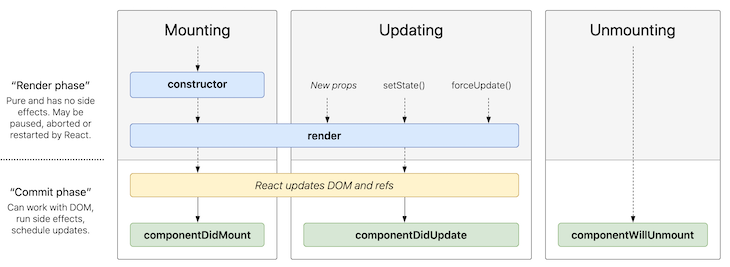
In contrast, the next diagram shows how things piece of work in the context of functional components.

This may sound strange at start, simply effects defined with useEffect are invoked later render. To exist more specific, it runs both after the first render and after every update. In dissimilarity to lifecycle methods, effects don't block the UI because they run asynchronously.
If you are new to React, I would recommend ignoring grade-based components and lifecycle methods and instead learn how to develop functional components and how to decipher the powerful possibilities of effects. Form-based components are rarely used in more contempo React development projects.
If you are a seasoned React developer and are familiar with class-based components, of class you have to do some of the same things in your projects today as you did two years ago when there were no Hooks.
As an case, it is pretty common to "do something" when the component is first rendered. The departure with Hooks here is subtle: y'all do not practice something afterward the component is mounted, you do something after the component is starting time presented to the user. As others take noted, Hooks force you lot to think more from the user's perspective.
The whole process may be hard to understand at get-go, but we'll expect at the different parts bit by fleck, so you'll accept a consummate understanding in the end.
The useEffect control menses at a glance
This department briefly describes the control flow of furnishings. The post-obit steps are carried out for a functional React component if at least one result is divers.
- Based on a country, prop, or context change, the component will be re-rendered.
- If one or more
useEffectdeclarations exist for the component, React checks eachuseEffectto determine whether it fulfills the conditions to execute the implementation (the body of the callback part provided as showtime statement). In this case, "conditions" mean that 1 or more dependencies take changed since the last render wheel.
Dependencies are array items provided as the optional 2d argument of the useEffect telephone call. Array values must be from the component scope (i.east., props, land, context, or values derived from the aforementioned).
- After execution of every event, scheduling of new effects occurs based on every upshot's dependencies. If an result does non specify a dependency array at all, it means that this effect is executed subsequently every render cycle.
- Cleanup is an optional step for every effect if the trunk of the
useEffectcallback part (first argument) returns a and so-called "cleanup callback role." In this case, the cleanup function gets invoked before the execution of the effect showtime with the second scheduling cycle. This too ways that if at that place is no second execution of an issue scheduled, the cleanup function is invoked earlier the React component gets destroyed.
I am quite sure that this lifecycle won't be entirely articulate to you if you have little feel with effects. That's why I explain every single aspect in bang-up item throughout this article. I encourage you to return to this section later on — I'thousand certain your next read will be totally clear.
How to execute side effects with useEffect
The signature of the useEffect Hook looks like this:
useEffect( () => { // execute side effect }, // optional dependency assortment [ // 0 or more entries ] ) Because the second argument is optional, the following execution is perfectly fine:
useEffect(() => { // execute side upshot }) Let's take a expect at an example. The user can change the certificate championship with an input field.
import React, { useState, useRef, useEffect } from "react"; office EffectsDemoNoDependency() { const [title, setTitle] = useState("default title"); const titleRef = useRef(); useEffect(() => { console.log("useEffect"); document.title = title; }); const handleClick = () => setTitle(titleRef.current.value); panel.log("render"); render ( <div> <input ref={titleRef} /> <push button onClick={handleClick}>change title</button> </div> ); } The useEffect argument is only divers with a single, mandatory argument to implement the actual result to execute. In our case, nosotros use the country variable representing the title and assign its value to certificate.title.
Because we skipped the 2nd argument, this useEffect is called after every render. Because we implemented an uncontrolled input field with the aid of the useRef Claw, handleClick is only invoked after the user clicks on the push. This causes a re-render considering setTitle performs a state change.
After every render cycle, useEffect is executed once again. To demonstrate this, I added two console.log statements.
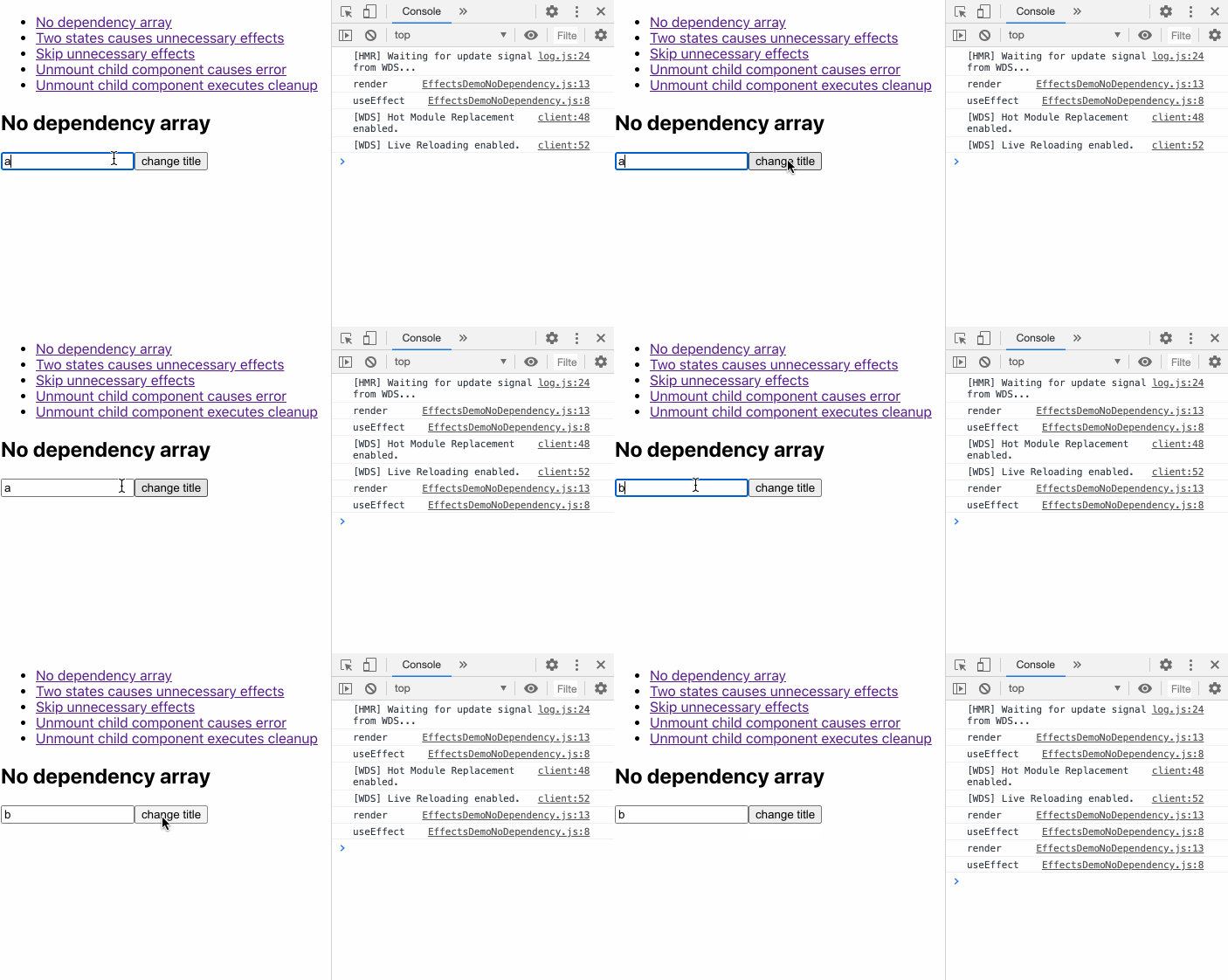
The first two log outputs are due to the initial rendering after the component was mounted. Let's add another state variable to the example to toggle a nighttime mode with the help of a checkbox.
role EffectsDemoTwoStates() { const [championship, setTitle] = useState("default championship"); const titleRef = useRef(); const [darkMode, setDarkMode] = useState(false); useEffect(() => { console.log("useEffect"); document.championship = title; }); console.log("render"); const handleClick = () => setTitle(titleRef.current.value); const handleCheckboxChange = () => setDarkMode((prev) => !prev); return ( <div className={darkMode ? "dark-style" : ""}> <label htmlFor="darkMode">dark mode</label> <input name="darkMode" type="checkbox" checked={darkMode} onChange={handleCheckboxChange} /> <input ref={titleRef} /> <push button onClick={handleClick}>alter title</button> </div> ); } However, this example leads to unnecessary effects when yous toggle the darkMode state variable.
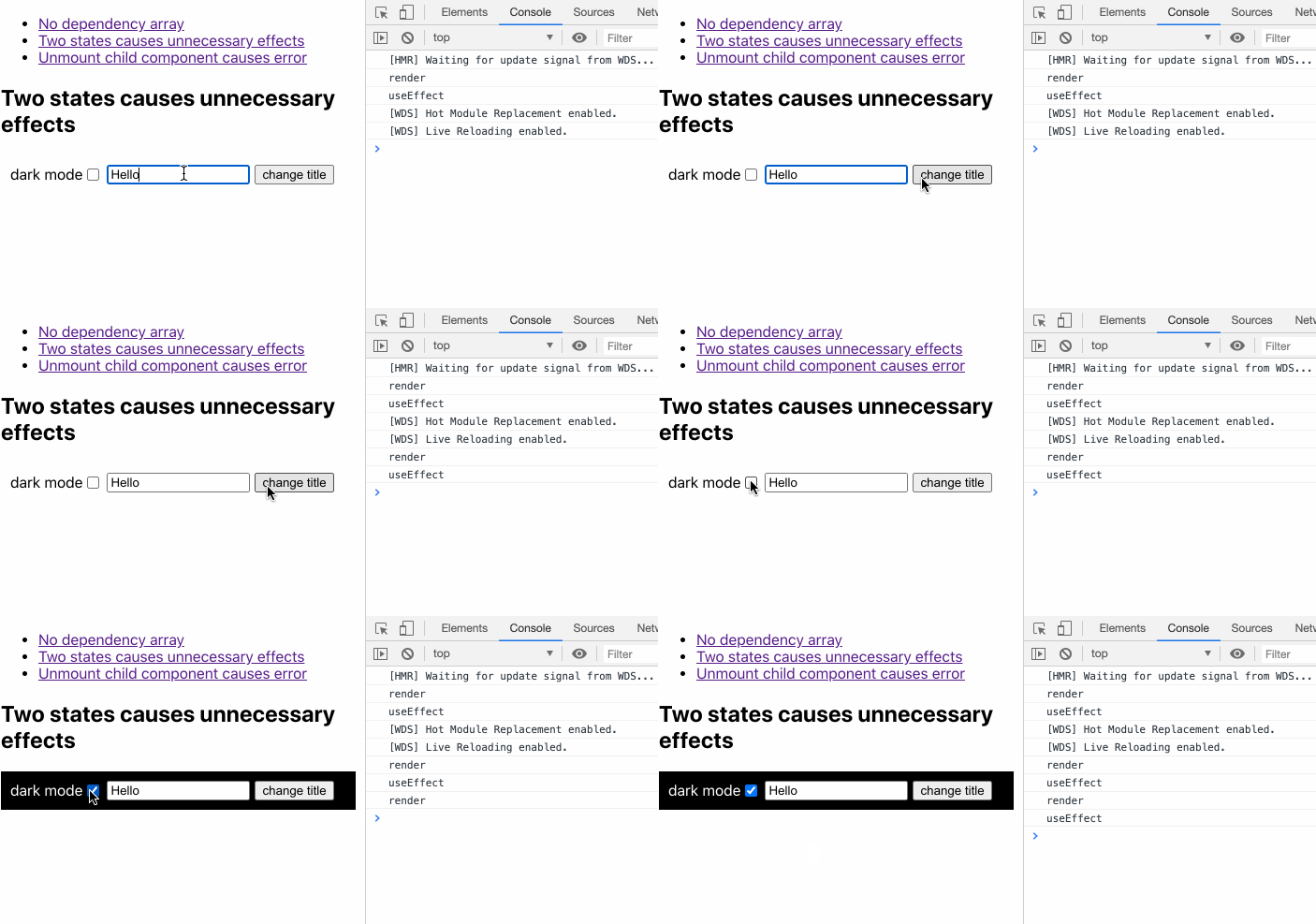
Of form, information technology'south not a huge deal in this example, simply you lot can imagine more than problematic use cases that crusade bugs or at least functioning issues. Allow's have a look at the following code and try to read the initial title from local storage, if available, in an boosted useEffect block.
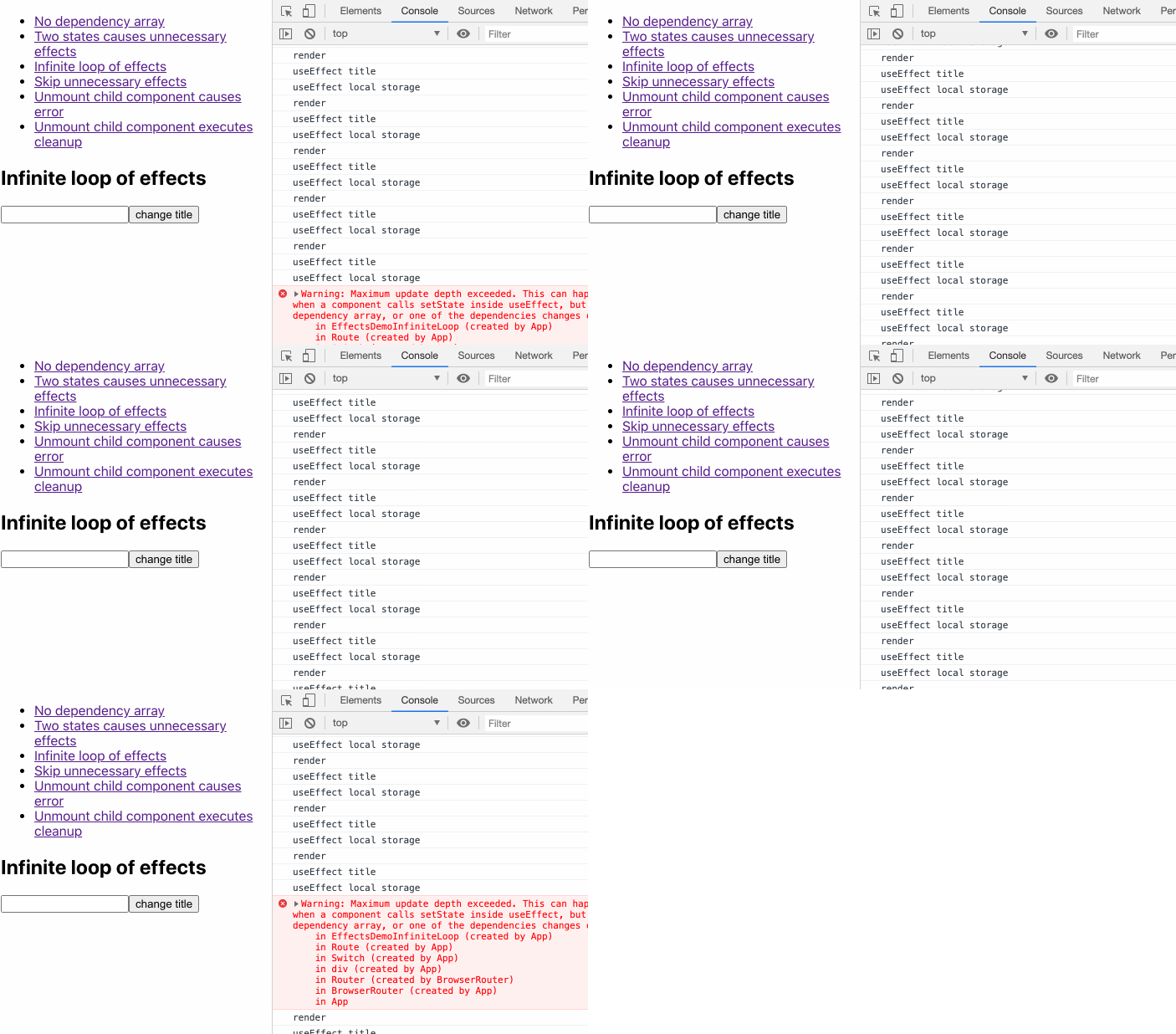
function EffectsDemoInfiniteLoop() { const [title, setTitle] = useState("default title"); const titleRef = useRef(); useEffect(() => { console.log("useEffect championship"); document.title = title; }); useEffect(() => { console.log("useEffect local storage"); const persistedTitle = localStorage.getItem("championship"); setTitle(persistedTitle || []); }); panel.log("return"); const handleClick = () => setTitle(titleRef.electric current.value); return ( <div> <input ref={titleRef} /> <push button onClick={handleClick}>change championship</push button> </div> ); } Equally you can run across, we have an infinite loop of effects considering every state change with setTitle triggers another effect, which updates the state again.
The importance of the dependency assortment
Permit'southward become back to our previous case with two states (title and dark mode). Why practice nosotros take the trouble of unnecessary effects?
Over again, if yous do not provide a dependency array, every scheduled useEffect is executed. This means that after every return cycle, every effect defined in the corresponding component is executed one after the other based on the positioning in the source code.
Then the order of your effect definitions thing. In our case, our single useEffect statement is executed whenever i of the state variables change.
Y'all have the power to opt out from this behavior. This is managed with dependencies y'all provide every bit assortment entries. In these cases, React only executes the useEffect statement if at least one of the provided dependencies has changed since the previous run. In other words, with the dependency array, you make the execution dependent on certain weather.
More often than not, this is what we want; we normally want to execute side effects after specific conditions, e.g., information has inverse, a prop changed, or the user first sees our component. Some other strategy to skip unnecessary furnishings is to prevent unnecessary re-renders in the first place with, e.g., React.memo, as we'll see later.
Back to our instance where we desire to skip unnecessary effects after an intended re-render, we just accept to add an array with championship as a dependency. With that, the effect is merely executed when the values between return cycles differ.
useEffect(() => { console.log("useEffect"); document.title = championship; }, [championship]); Here'southward the consummate code snippet:
function EffectsDemoTwoStatesWithDependeny() { const [title, setTitle] = useState("default title"); const titleRef = useRef(); const [darkMode, setDarkMode] = useState(false); useEffect(() => { console.log("useEffect"); document.title = title; }, [title]); console.log("render"); const handleClick = () => setTitle(titleRef.electric current.value); const handleCheckboxChange = () => setDarkMode((prev) => !prev); return ( <div className={darkMode ? "view dark-mode" : "view"}> <label htmlFor="darkMode">night mode</characterization> <input name="darkMode" type="checkbox" checked={darkMode} onChange={handleCheckboxChange} /> <input ref={titleRef} /> <push onClick={handleClick}>alter title</button> </div> ); } As you lot tin can see in the recording, effects are only invoked every bit expected on pressing the button.
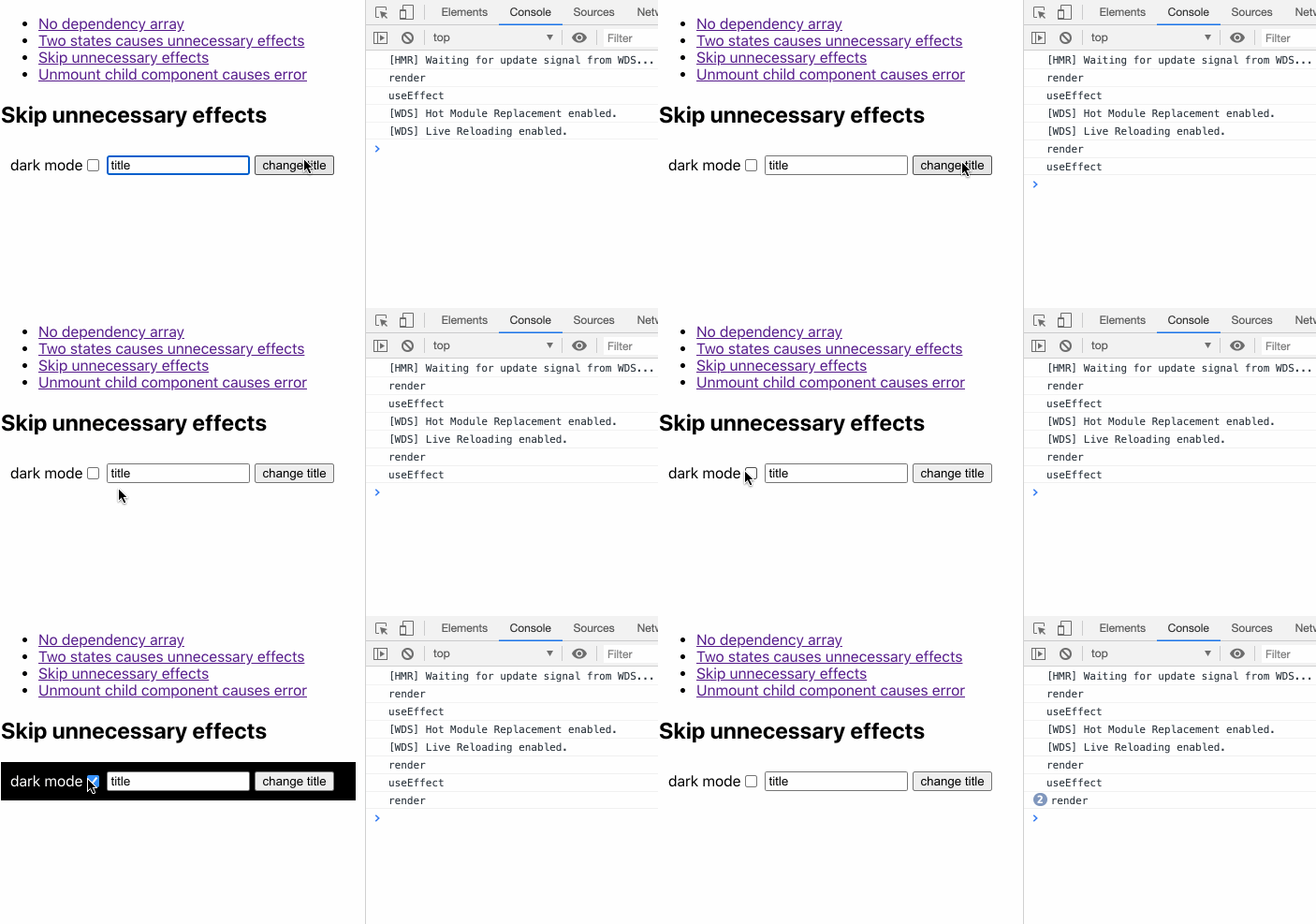
It is too possible to add an empty dependency array. In this example, furnishings are only executed once; it is similar to the componentDidMount() lifecycle method. To demonstrate this, permit's take a look at the previous example with the space loop of effects.
function EffectsDemoEffectOnce() { const [title, setTitle] = useState("default title"); const titleRef = useRef(); useEffect(() => { console.log("useEffect championship"); document.title = title; }); useEffect(() => { panel.log("useEffect local storage"); const persistedTitle = localStorage.getItem("title"); setTitle(persistedTitle || []); }, []); console.log("render"); const handleClick = () => setTitle(titleRef.current.value); return ( <div> <input ref={titleRef} /> <button onClick={handleClick}>change title</button> </div> ); } We just added an empty array every bit our 2d statement. Because of this, the outcome is simply executed once after the starting time render and skipped for the post-obit render cycles.
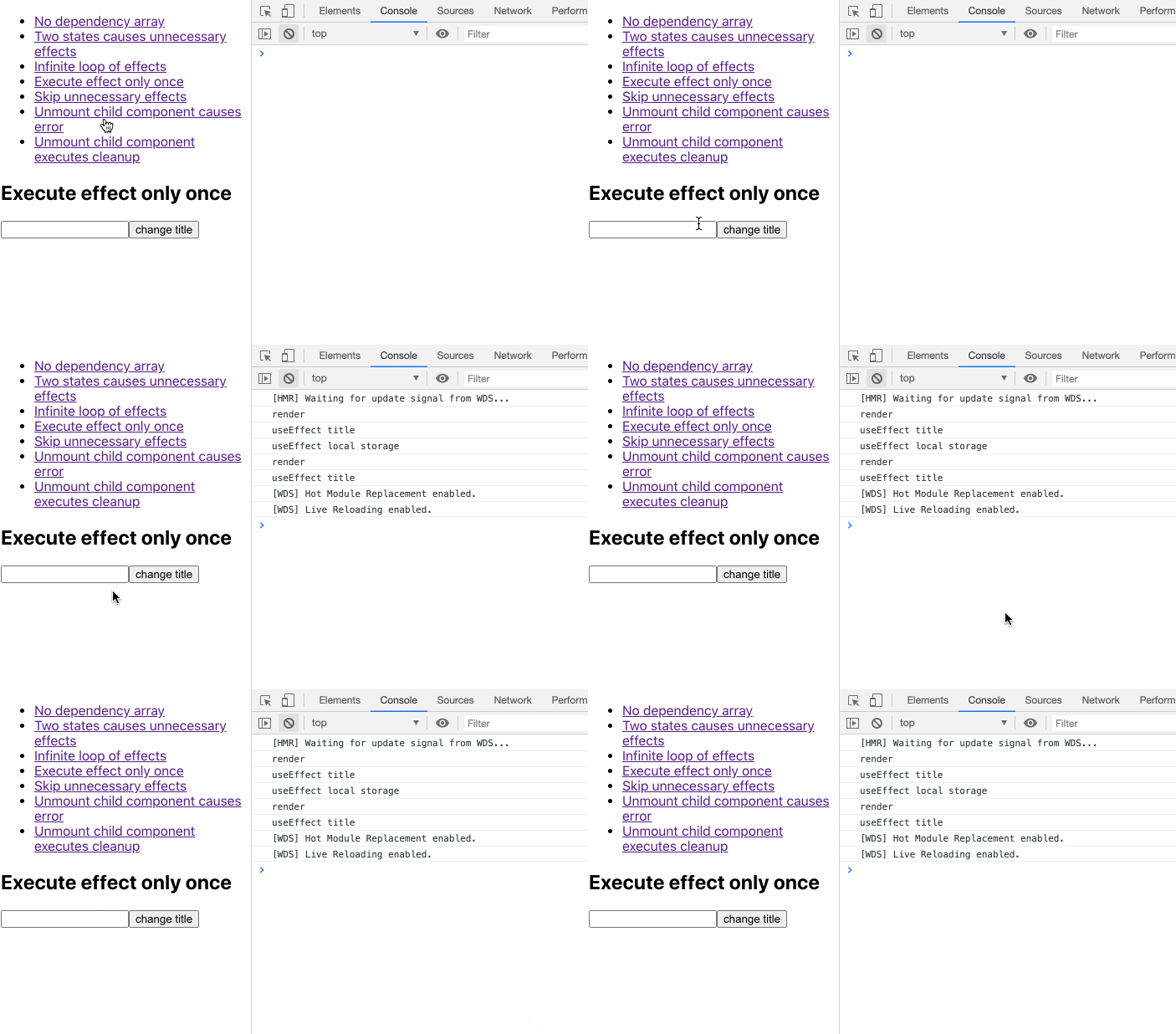
If you think well-nigh information technology, this behavior makes sense. In principle, the dependency array says, "Execute the effect provided past the kickoff argument after the adjacent render cycle whenever one of the arguments changes." However, we don't have any statement, and so dependencies will never alter in the future.
That'south why using an empty dependency array makes React invoke an effect only one time — subsequently the first return. The second render along with the second useEffect championship is due to the country alter invoked by setTitle() after we read the value from local storage.
The rules of Hooks: A brief aside
Before we keep with more examples, we have to talk about the general rules of Hooks. These are non exclusive to the useEffect Hook, only it's important to understand at which places in your code y'all tin can define effects. You need to follow rules to utilise Hooks:
- Hooks tin only be invoked from the top-level function constituting your functional React component.
- Hooks may not be chosen from nested lawmaking (eastward.g., loops, conditions, or another function body).
- Custom Hooks are special functions, however, and Hooks may exist called from the top-level office of the custom Hook. In addition, rule ii is also true.
How the React Hooks ESLint plugin promotes understanding of the rules of Hooks
There's a handy ESLint plugin that assists you in following the rules of Hooks. It lets you know if you violate ane of the rules.
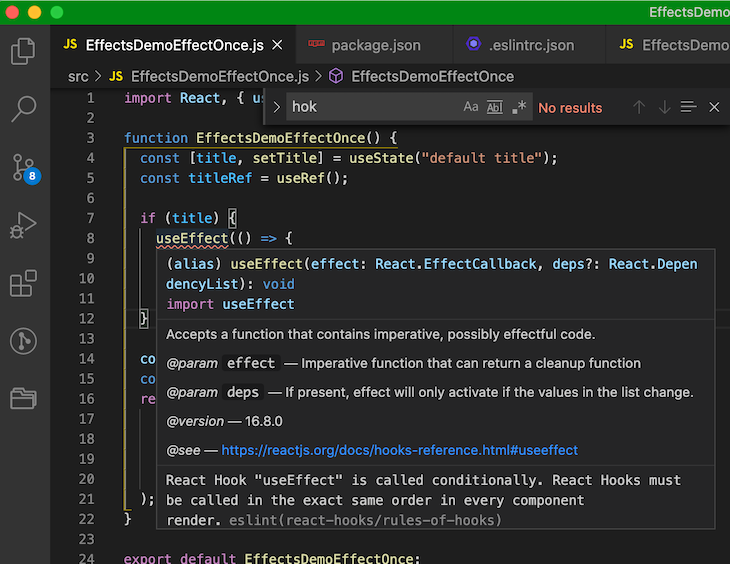
In addition, it helps you to provide a correct dependency assortment for effects in order to prevent bugs.
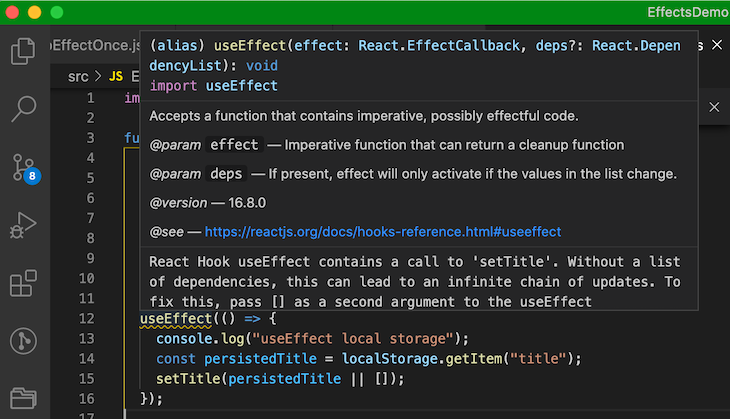
This plugin is great considering, in do, y'all might miss the opportunity to add dependencies to the list; this is non always obvious at starting time. Besides, careless mistakes tin happen at any time. I like the plugin because its messages foster learning more about how effects work.
If y'all don't empathize why the plugin wants you to add a sure dependency, please don't prematurely ignore it! You should at least accept a very skilful explanation for doing and so. I have recently discovered that, in some circumstances, you lot most likely will have a issues if y'all omit the dependency.
useEffect(() => { // ... // eslint-disable-next-line react-hooks/exhaustive-deps }, []); Finally, exist aware that the plugin is not omniscient. You take to accept that the ESLint plugin — even though it'due south awesome — cannot understand the runtime behavior of your code. It tin only use static code analysis. There are certainly cases where the plugin cannot assist yous.
However, I have no arguments against integrating the plugin into your project setup. It reduces error-proneness and increases robustness. In addition, take a closer await at the provided suggestions; they might enable new insights into concepts you haven't grasped completely. It is worth googling the message to learn more than well-nigh the background in discussions.
With all that said, you shouldn't be and then dogmatic as to satisfy the plugin all the time. Check out the setup in the companion project for this article.
What are legitimate dependency assortment items?
This brings us to an important question: What items should be included in the dependency array? According to the React Docs, you have to include all values from the component scope that change their values between re-renders.
What does this mean, exactly? All external values referenced inside of the useEffect callback office, such as props, land variables, or context variables, are dependencies of the effect. Ref containers (i.e., what you directly get from useRef() and not the current property) are also valid dependencies. Even local variables, which are derived from the aforementioned values, have to exist listed in the dependency array.
It is essential to understand the conceptual thinking of effects; the React team wants you lot to treat every value used inside of the result as dynamic. So even if you lot use a non-function value inside the effect, and you are pretty sure this value is unlikely to change, you lot should include the value in the dependency array.
That'southward because — however unlikely it may be — there is even so a chance the value will modify. Who knows whether the component will go refactored? Suddenly, the value is no longer constant in every instance, and you might take introduced a potential stale prop/state/context bug.
Therefore, make sure to add every value from the component telescopic to the list of dependencies because you should treat every value equally mutable. Remember that if at least one of the dependencies in the assortment is different from the previous return, the result volition exist rerun.
Utilizing cleanup functions
The side by side snippet shows an example to demonstrate a problematic effect.
function Counter() { const [count, setCount] = useState(0); useEffect(() => { const interval = setInterval(function () { setCount((prev) => prev + 1); }, thousand); }, []); return <p>and the counter counts {count}</p>; } function EffectsDemoUnmount() { const [unmount, setUnmount] = useState(false); const renderDemo = () => !unmount && <Counter />; return ( <div> <button onClick={() => setUnmount(truthful)}>Unmount child component</button> {renderDemo()} </div> ); } This lawmaking implements a React component representing a counter that increases a number every second. The parent component renders the counter and allows y'all to destroy the counter past clicking on a push button. Take a look at the recording to meet what happens when a user clicks on that button.
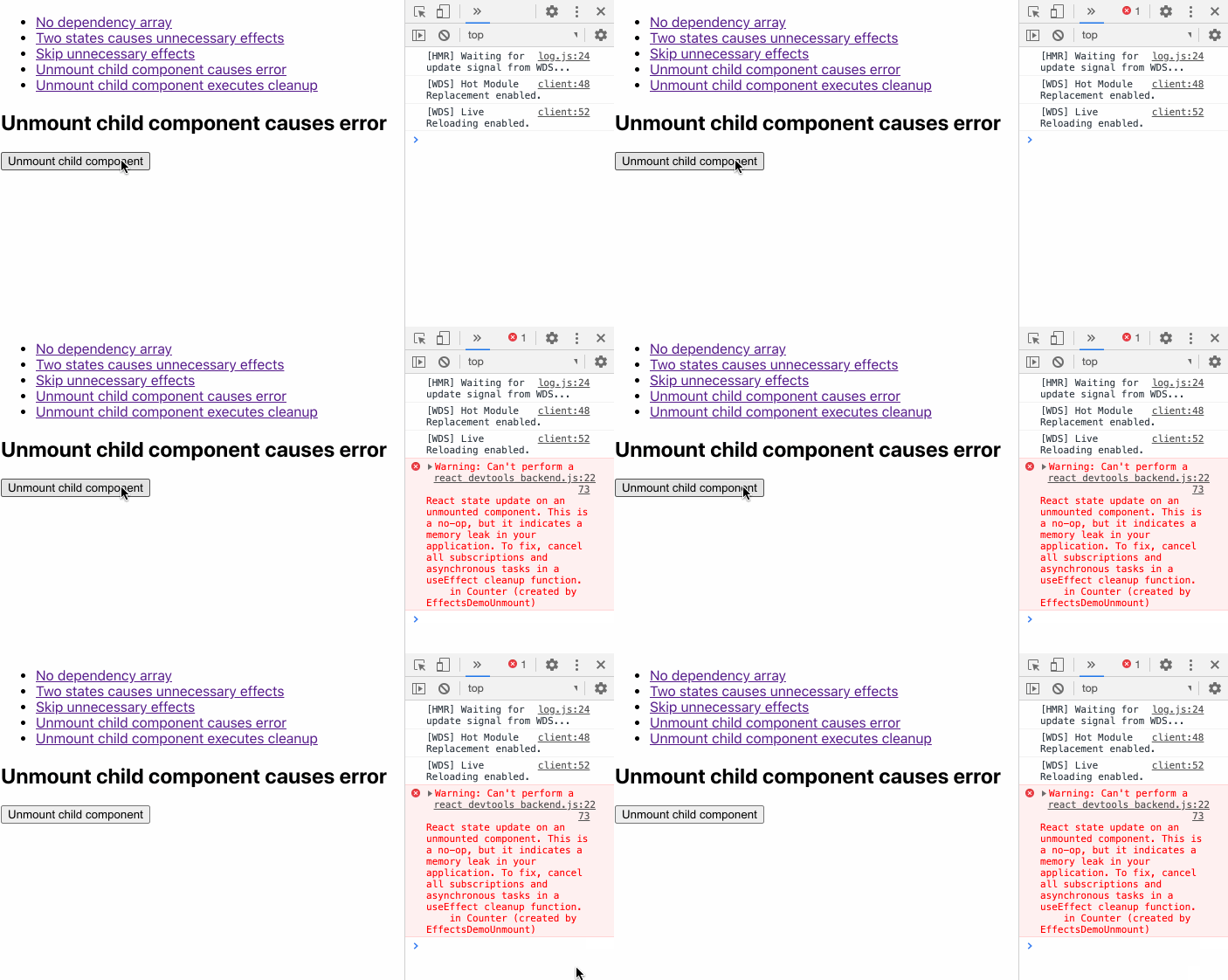
The child component has registered an interval that invokes a function every second. Even so, the component was destroyed without unregistering the interval. After the component is destroyed, the interval is yet active and wants to update the component'south land variable (count), which no longer exists.
The solution is to unregister the interval correct before unmount. This is possible with a cleanup function. Therefore, you have to return a callback function inside the effect'south callback trunk.
useEffect(() => { const interval = setInterval(function () { setCount((prev) => prev + i); }, 1000); // return optional part for cleanup // in this case acts similar componentWillUnmount return () => clearInterval(interval); }, []); I want to emphasize that cleanup functions are not only invoked before destroying the React component. An effect's cleanup function gets invoked every fourth dimension, right before the execution of the adjacent scheduled effect.
Let'due south accept a closer look at our instance. We used a trick to have an empty dependency array in the first identify, and so the cleanup function acts like a componentWillUnmount() lifecycle method. If we exercise not call setCount with a callback function that gets the previous value equally an argument, we need to come up with the post-obit code, wherein we add count to the dependencies array:
useEffect(() => { console.log("useEffect") const interval = setInterval(function () { setCount(count + 1); }, 1000); // return optional role for cleanup // in this case, this cleanup fn is called every time count changes return () => { console.log("cleanup"); clearInterval(interval); } }, [count]); 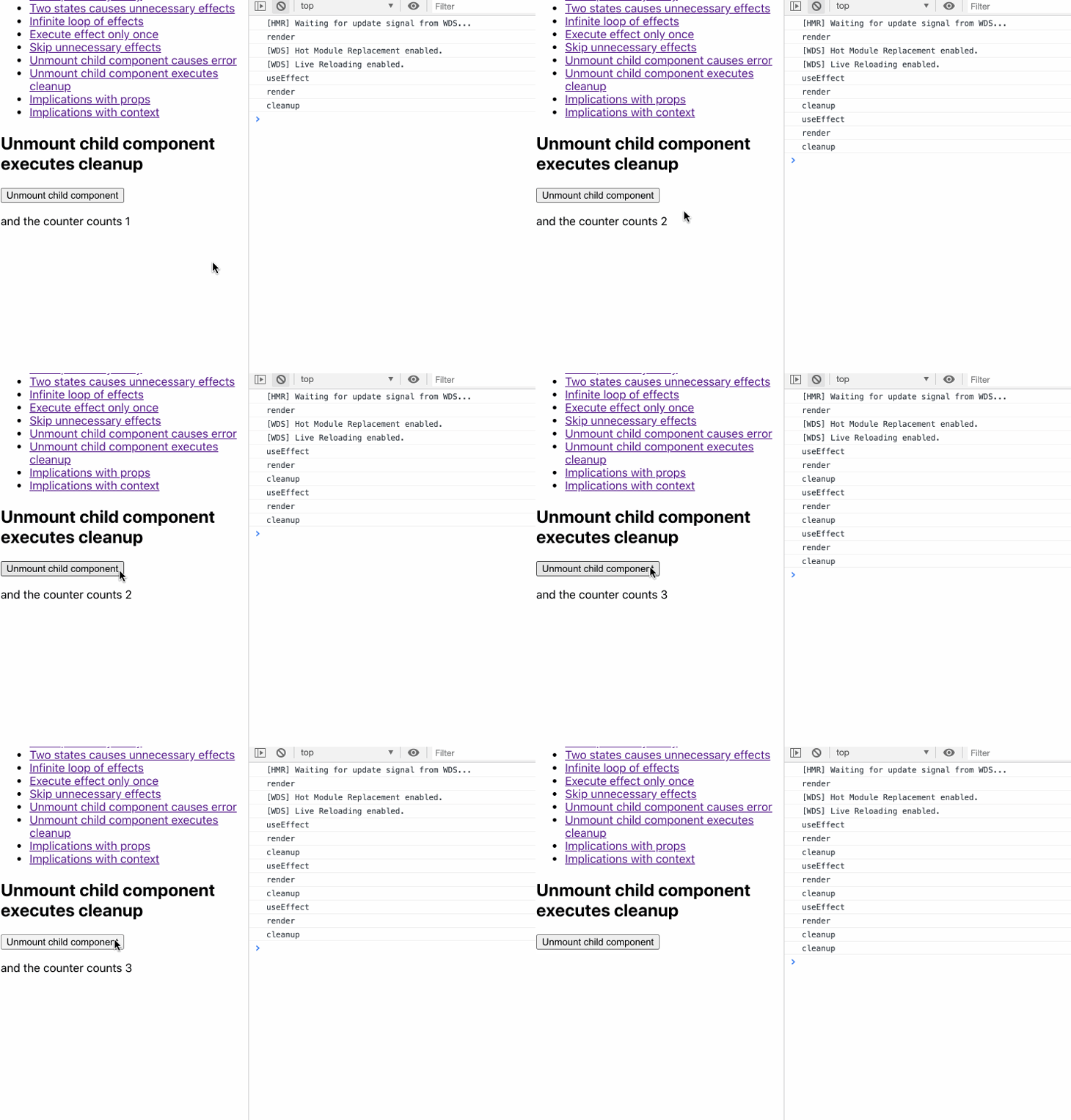
In comparison, the former instance executes the cleanup function simply once — on mount — because we prevented the use of the country variable (count) directly.
useEffect(() => { console.log("useEffect") const interval = setInterval(function () { setCount(prev => prev + one); }, 1000); // return optional office for cleanup // in this case, this cleanup fn is called every time count changes return () => { console.log("cleanup"); clearInterval(interval); } }, []); 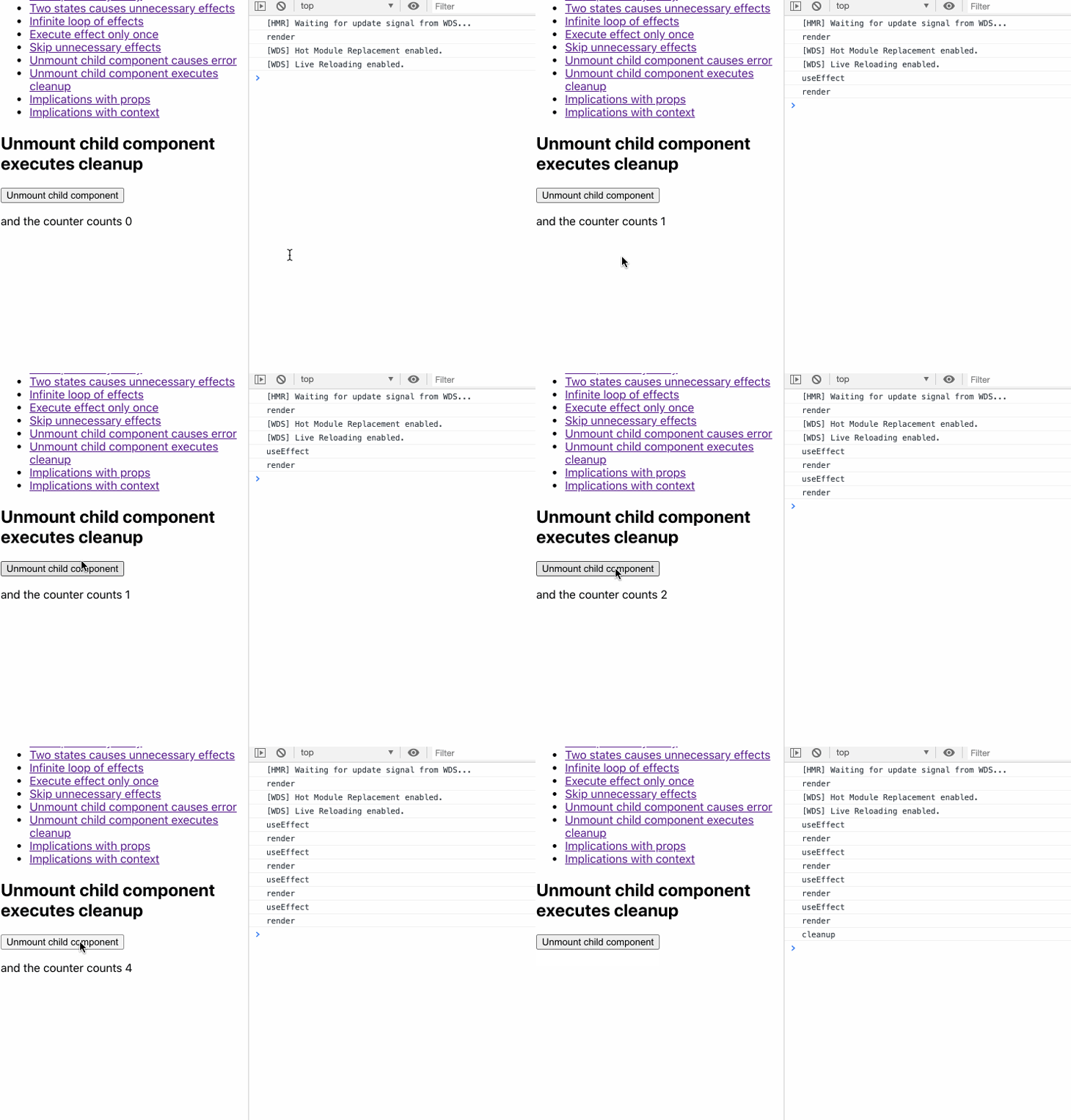
In this context, the latter approach is a tiny performance optimization because we reduce the number of cleanup function calls.
I hope these example have convinced y'all that working with effects is different from lifecycle methods and that it is ultimately not benign to try to mimic these methods.
Implications of prop and state changes
There is a natural correlation between prop changes and the execution of effects because they crusade re-renders, and as we already know, furnishings are scheduled after every render cycle.
Consider the post-obit example. The programme is that the Counter component'due south interval can be configured by a prop with the aforementioned name.
part Counter({ interval }) { const [count, setCount] = useState(0); useEffect(() => { const counterInterval = setInterval(function () { setCount((prev) => prev + 1); }, interval); return () => clearInterval(counterInterval); }, []); return <p>and the counter counts {count}</p>; } role EffectsDemoProps() { const [interval, setInterval] = useState(1000); return ( <div> <input blazon="text" value={interval} onChange={(evt) => setInterval(evt.target.value)} /> <Counter interval={interval} /> </div> ); } The handy ESLint plugin points out that we are missing something important: considering nosotros haven't added the interval prop to the dependency array (having instead divers an empty array), the alter to the input field in the parent component is without consequence. The initial value of chiliad is used even after nosotros adjust the value of the input field.
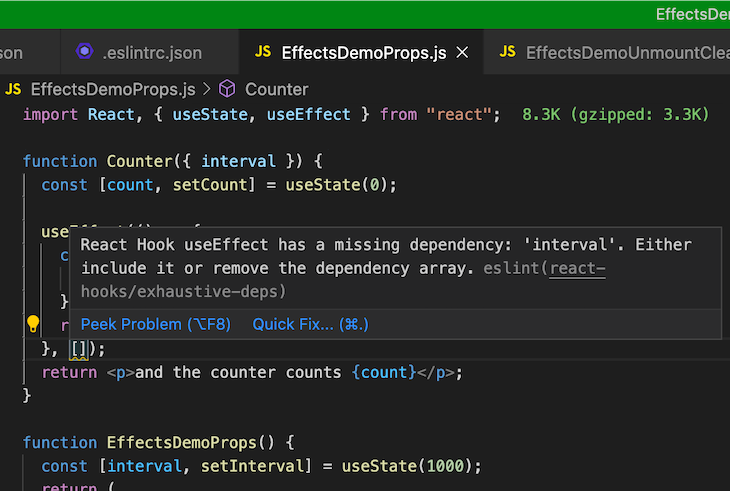
Instead, we have to add together the prop to the dependency array:
useEffect(() => { const counterInterval = setInterval(function () { setCount((prev) => prev + 1); }, interval); render () => clearInterval(counterInterval); }, [interval]); At present things look much ameliorate.
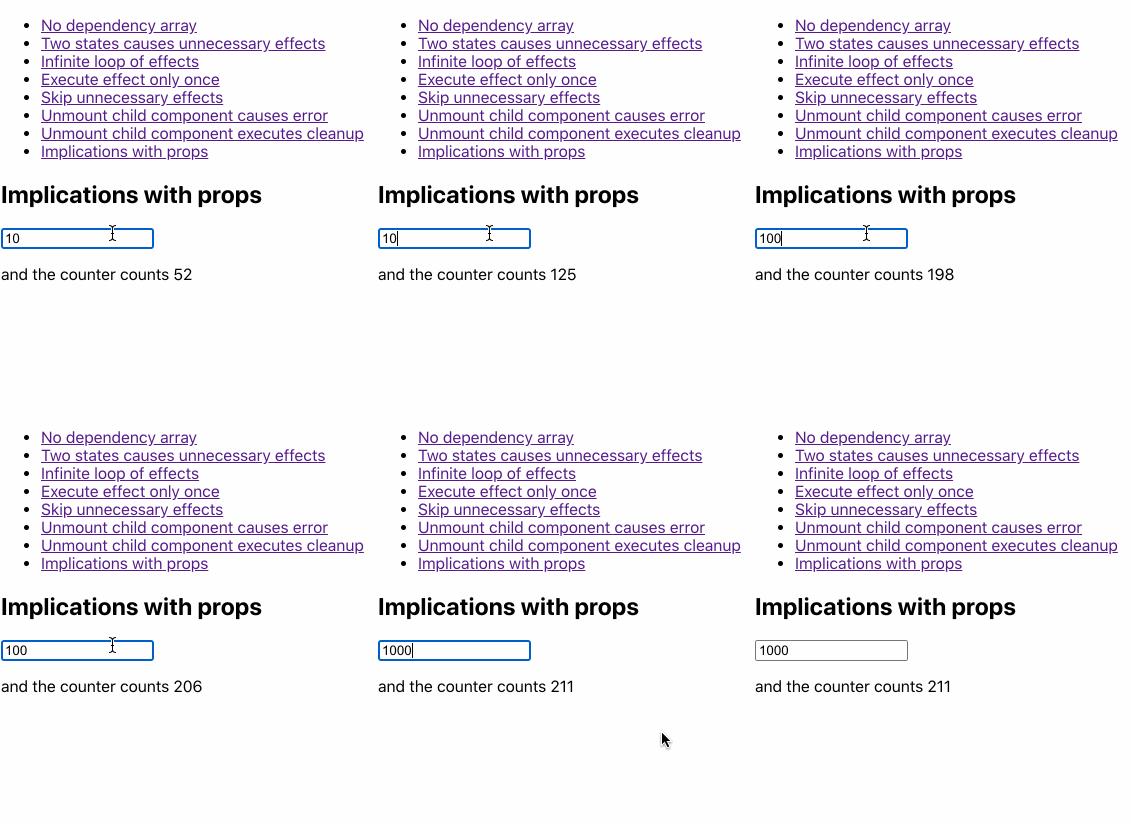
More on prop changes, and using the useCallback Claw
Allow's extend the example a scrap to demonstrate more pivotal concepts in conjunction with prop changes.
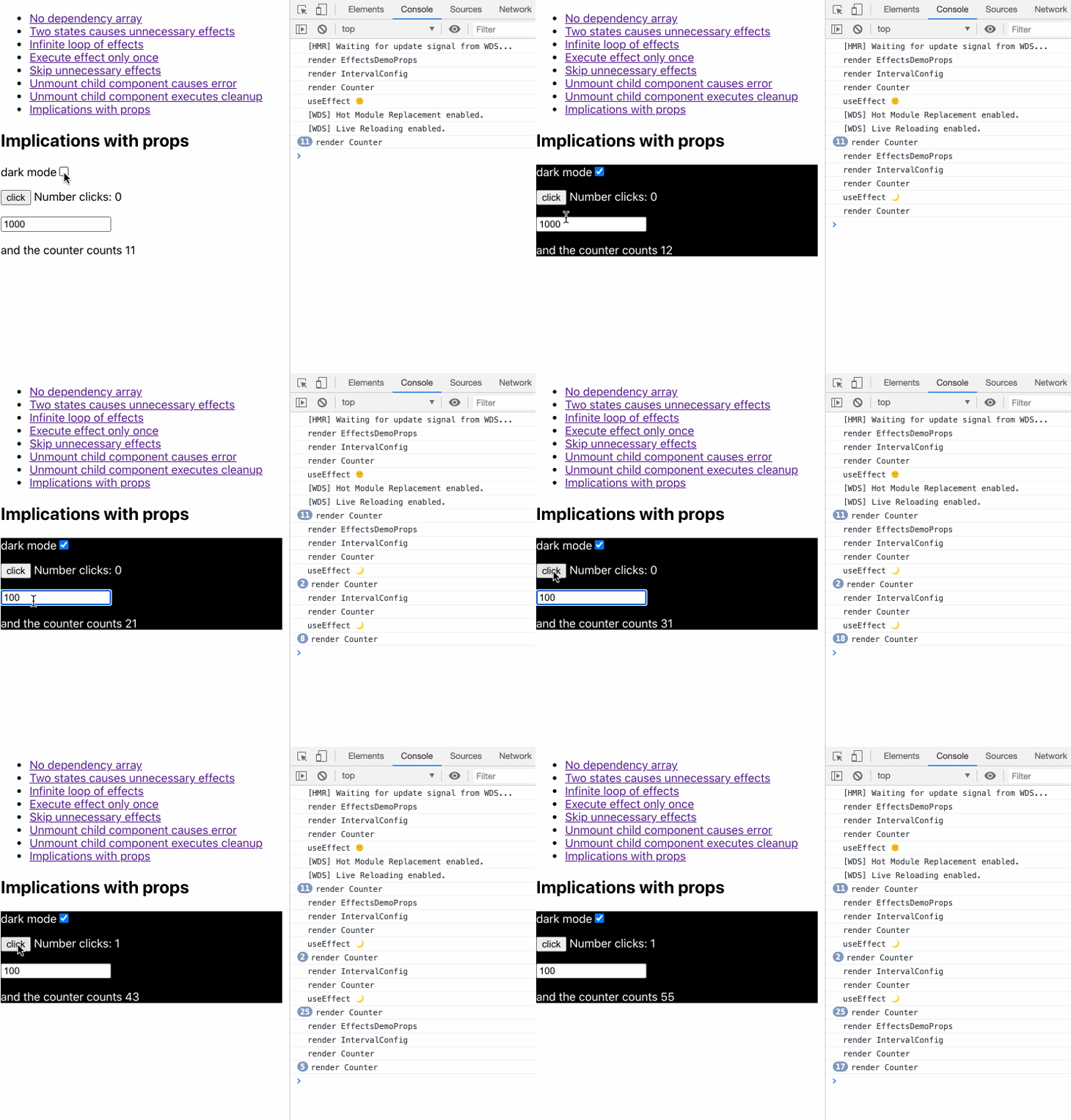
const Counter = ({ interval, onDarkModeChange }) => { console.log("render Counter"); const [count, setCount] = useState(0); useEffect(() => { console.log(`useEffect ${onDarkModeChange()}`); const counterInterval = setInterval(function () { setCount((prev) => prev + i); }, interval); return () => clearInterval(counterInterval); }, [interval, onDarkModeChange]); return <p>and the counter counts {count}</p>; }; const IntervalConfig = ({ onDarkModeChange }) => { console.log("return IntervalConfig"); const [interval, setInterval] = useState(thousand); const onChange = (evt) => setInterval(evt.target.value); return ( <div> <input type="text" value={interval} onChange={onChange} /> <Counter interval={interval} onDarkModeChange={onDarkModeChange} /> </div> ); }; const EffectsDemoProps = () => { console.log("return EffectsDemoProps"); const [numberClicks, setNumberClicks] = useState(0); const [darkMode, setDarkMode] = useState(false); const onDarkModeChange = () => (darkMode ? "🌙" : "🌞"); return ( <div style={ darkMode ? { backgroundColor: "black", color: "white" } : { backgroundColor: "white", color: "black" } } > <label htmlFor="darkMode">dark mode</characterization> <input proper name="darkMode" type="checkbox" checked={darkMode} onChange={() => setDarkMode((prev) => !prev)} /> <p> <push onClick={() => setNumberClicks((prev) => prev + one)}> click </push button> <span> Number clicks: {numberClicks}</span> </p> <IntervalConfig onDarkModeChange={onDarkModeChange} /> </div> ); }; I added log statements to point all component renderings, as well as the invocation of our useEffect statement. Let's take a look at what happens.
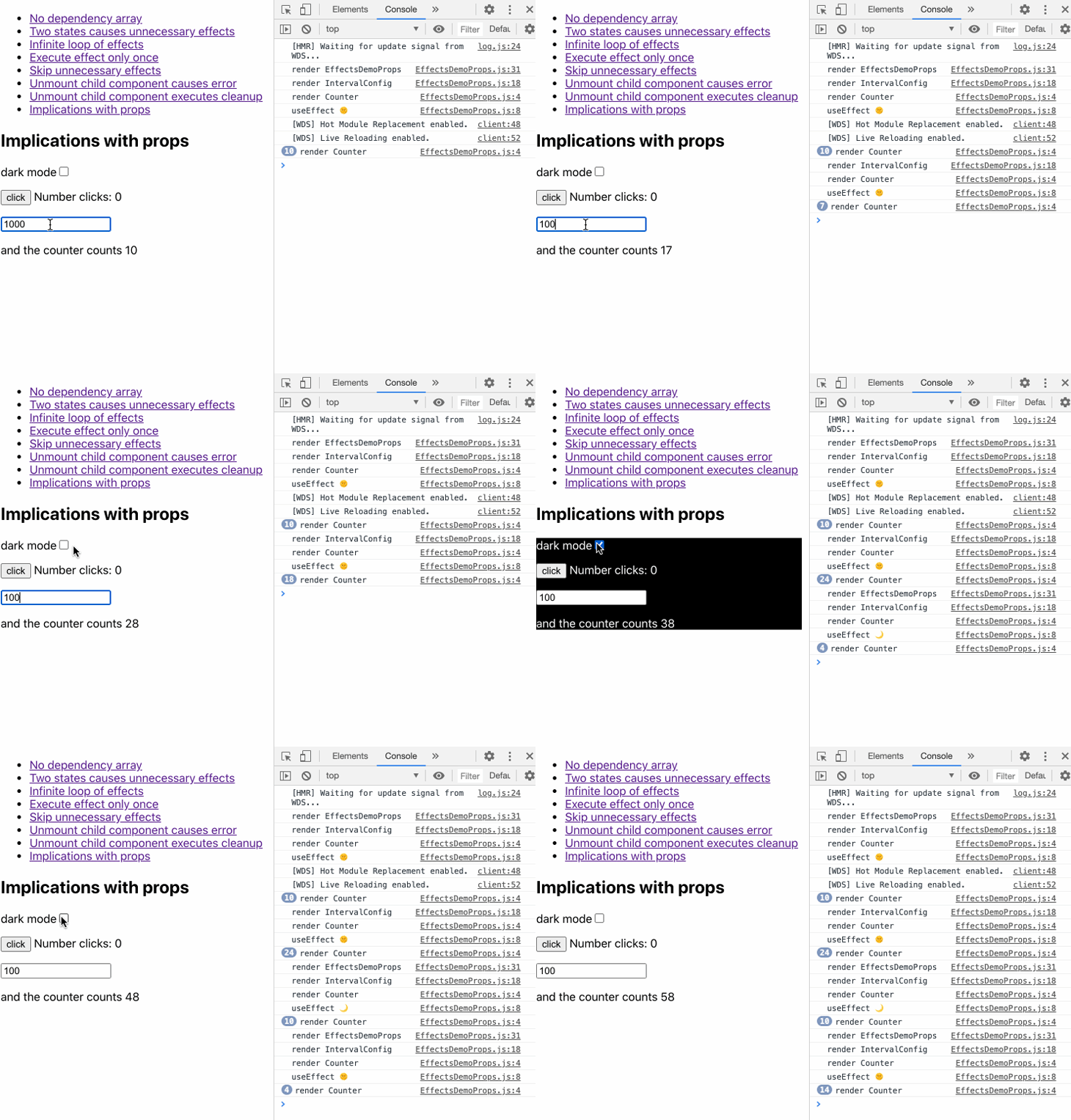
So far, so good — we can toggle the nighttime fashion checkbox, and the effect should exist executed, too. The callback function to be executed, onDarkModeChange, is passed down the component tree to the Counter component. We added it to the dependency assortment of the useEffect statement as suggested past the ESLint plugin.
useEffect(() => { console.log(`useEffect ${onDarkModeChange()}`); const counterInterval = setInterval(office () { setCount((prev) => prev + ane); }, interval); return () => clearInterval(counterInterval); }, [interval, onDarkModeChange]); Every bit yous can see from the recording, the effect is executed if one of the ii props, interval or onDarkModeChange, changes.
All expert? Not so fast — equally you tin can encounter from the next recording, if nosotros click on the button, the effect is mistakenly executed.
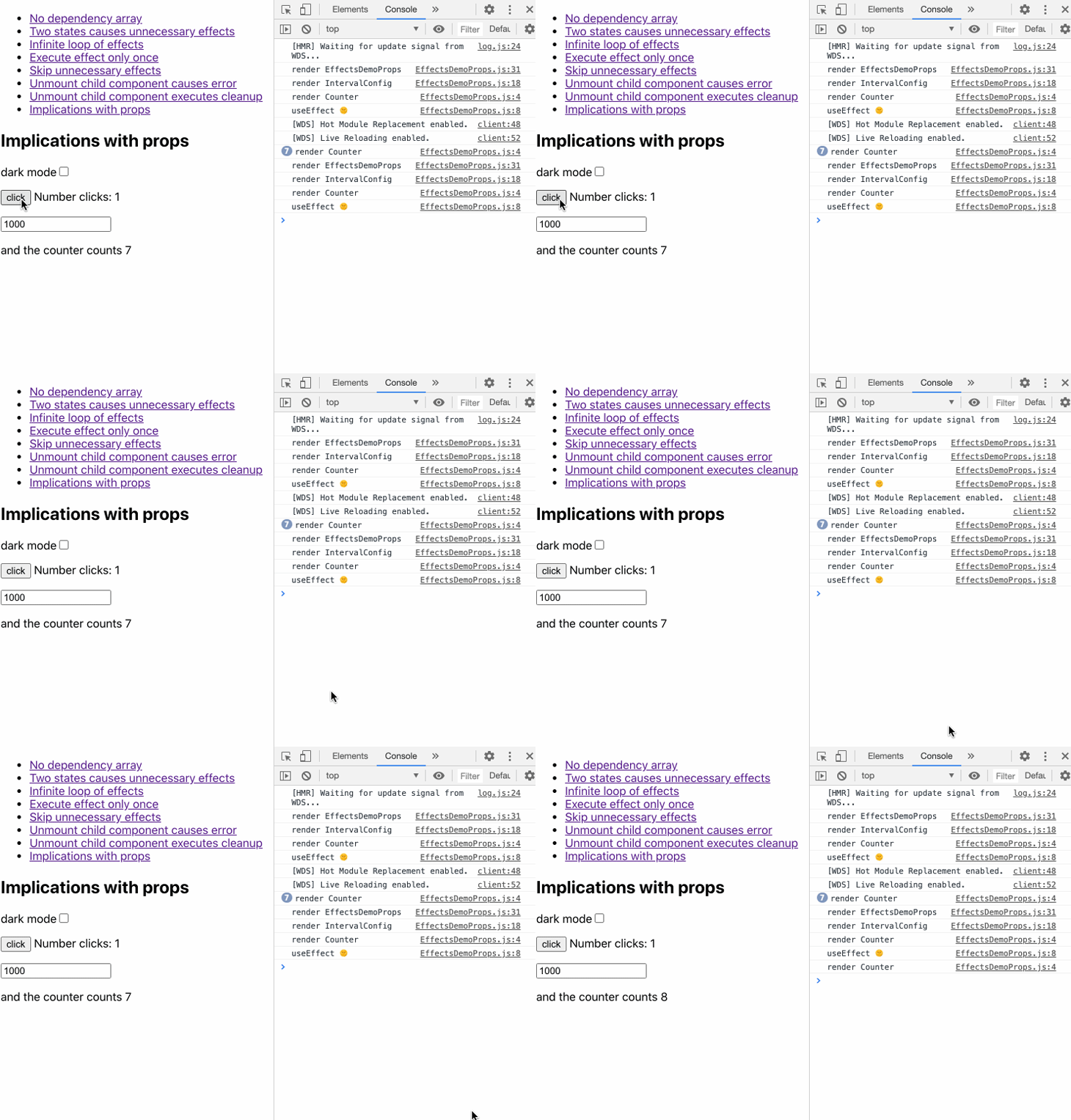
Sure, the state of the EffectsDemoProps changes, and this component is rendered along with its child components. The solution is to use React.memo, correct?
const Counter = React.memo(({ interval, onDarkModeChange }) => { // ... }); const IntervalConfig = React.memo(({ onDarkModeChange }) => { // ... }); Well, the components are still rendered, and the effect is still mistakenly executed.
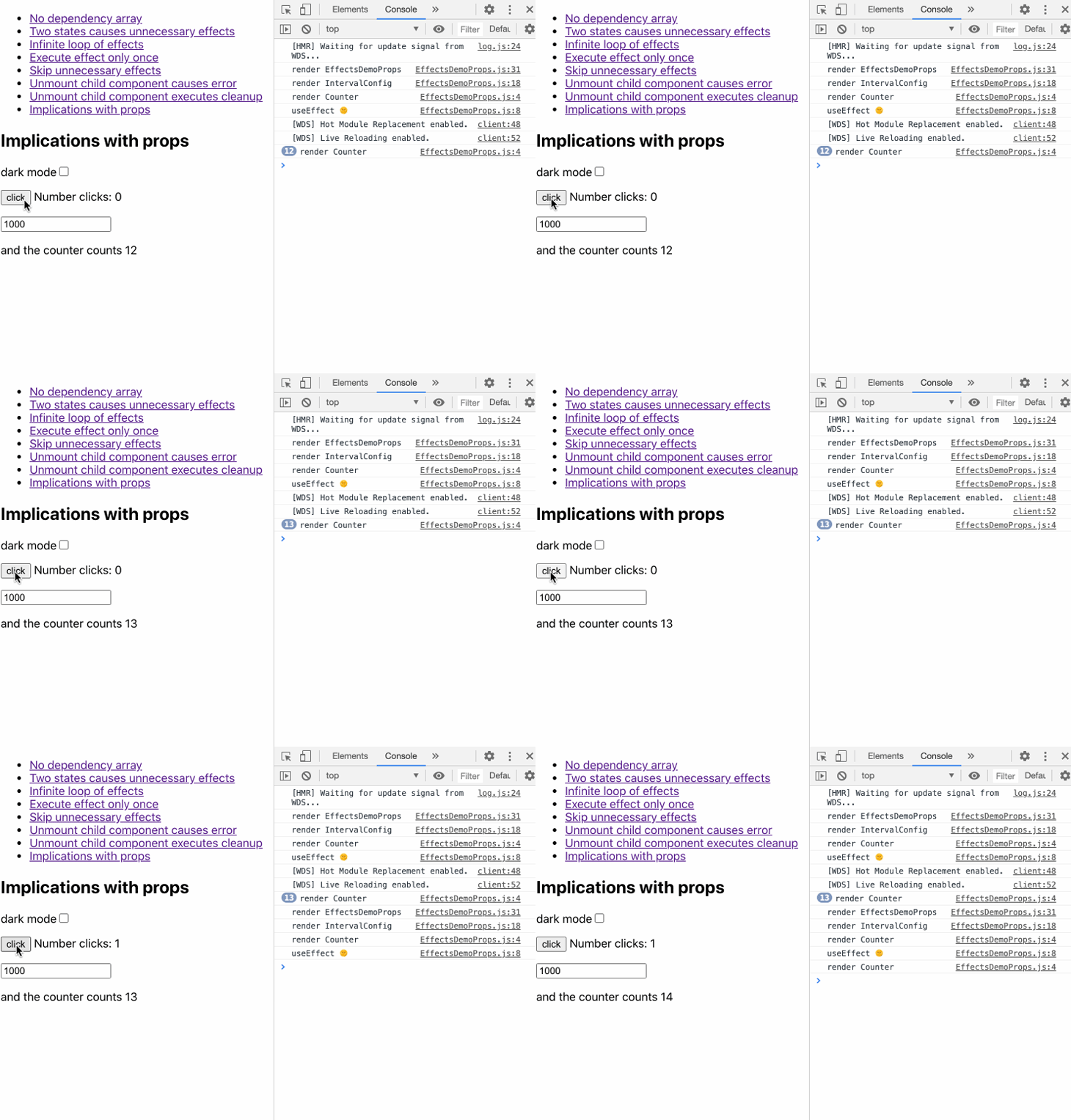
Why is our Counter component's issue executed? The problem lies in the onDarkModeChange function.
const EffectsDemoProps = () => { // ... const onDarkModeChange = () => (darkMode ? "🌙" : "🌞"); // ... }; On button click, the numberClicks land of the EffectsDemoProps component gets inverse, and the component is thus re-rendered.
This is because onDarkModeChange is defined inline of the component and gets recreated every time the component re-renders. So fifty-fifty if you utilise React.memo on the child components, they become re-rendered considering the passed onDarkModeChange function prop points to another reference every time.
This is why it is crucial to understand the identity of values. In contrast to recreated archaic values like numbers, a recreated function points to some other "cell" in memory. That's why the office values differ.
We can fix this with the useCallback Hook. In addition, we exercise not necessarily need to utilize React.memo considering it's non really a trouble to get the child components re-rendered in our example. However, we want to execute the event but when the interval value or the darkMode value changes.
import React, { useState, useEffect, useCallback } from "react"; const Counter = ({ interval, onDarkModeChange }) => { // ... }; const IntervalConfig = ({ onDarkModeChange }) => { // ... }; const EffectsDemoProps = () => { // .. const onDarkModeChange = useCallback(() => { return darkMode ? "🌙" : "🌞"; }, [darkMode]); // ... }; With useCallback, React just creates a new role whenever one of the dependencies changes — in our instance, the darkMode state variable. With this in place, our example works as expected.
useCallback with useContext
If we modify the instance and utilize React Context with the useContext Claw instead of passing down props to the child components, we still need to use useCallback for the onDarkModeChange dependency. The reasons are the same every bit in the previous section.
import React, { useState, useEffect, useCallback, useContext } from "react"; const EffectsContext = React.createContext(null); const Counter = ({ interval }) => { const [count, setCount] = useState(0); const { onDarkModeChange } = useContext(EffectsContext); useEffect(() => { const counterInterval = setInterval(function () { setCount((prev) => prev + i); }, interval); return () => clearInterval(counterInterval); }, [interval, onDarkModeChange]); render <p>and the counter counts {count}</p>; }; const IntervalConfig = () => { const [interval, setInterval] = useState(1000); const onChange = (evt) => setInterval(evt.target.value); render ( <div> <input type="text" value={interval} onChange={onChange} /> <Counter interval={interval} /> </div> ); }; const EffectsDemoContext = () => { const [numberClicks, setNumberClicks] = useState(0); const [darkMode, setDarkMode] = useState(false); const onDarkModeChange = useCallback(() => { return darkMode ? "🌙" : "🌞"; }, [darkMode]); return ( <div mode={ darkMode ? { backgroundColor: "blackness", colour: "white" } : { backgroundColor: "white", color: "black" } } > <characterization htmlFor="darkMode">dark mode</characterization> <input name="darkMode" type="checkbox" checked={darkMode} onChange={() => setDarkMode((prev) => !prev)} /> <p> <button onClick={() => setNumberClicks((prev) => prev + i)}> click </button> <span> Number clicks: {numberClicks}</span> </p> <EffectsContext.Provider value={{ onDarkModeChange }}> <IntervalConfig /> </EffectsContext.Provider> </div> ); }; useEffect within of custom Hooks
Custom Hooks are awesome because they pb to various benefits:
- Reusable code
- Smaller components because of outsourced code (effects)
- More semantic code due to the role calls of the custom Hooks within of components
- Furnishings tin can be tested when used inside of custom Hooks, every bit we'll run into in the next department
The following example represents a custom Hook for fetching information. We moved the useEffect code block into a function representing the custom Hook. Annotation that this is a rather simplified implementation that might non embrace all your project's requirements. You tin can find more production-set custom fetch Hooks here.
const useFetch = (url, initialValue) => { const [data, setData] = useState(initialValue); const [loading, setLoading] = useState(true); useEffect(() => { const fetchData = async function () { try { setLoading(true); const response = wait axios.become(url); if (response.status === 200) { setData(response.data); } } catch (error) { throw error; } finally { setLoading(imitation); } }; fetchData(); }, [url]); render { loading, information }; }; function EffectsDemoCustomHook() { const { loading, data } = useFetch( "https://jsonplaceholder.typicode.com/posts/" ); return ( <div className="App"> {loading && <div className="loader" />} {data?.length > 0 && data.map((blog) => <p fundamental={blog.id}>{blog.title}</p>)} </div> ); } The first statement within our React component, EffectsDemoCustomHook, uses the custom Hook chosen useFetch. As y'all can see, using a custom Hook like this is more semantic than using an effect directly inside of the component.
Business logic is nicely abstracted out of the component. Nosotros just have to employ our custom Hook's nice API that returns the state variables loading and information.
The consequence inside of the custom Claw is dependent on the scope variable url that is passed to the Hook as a prop. This is considering we have to include information technology in the dependency array. So fifty-fifty though we don't foresee the URL irresolute in this example, it's still good practice to define information technology every bit a dependency. As mentioned to a higher place, in that location is a chance that the value will change at runtime in the future.
Additional thoughts on functions used within of effects
If you take a closer look at the last example, we divers the function fetchData within the effect because we but use information technology there. This is a best practice for such a utilise example. If we ascertain it exterior the result, nosotros need to come up with unnecessarily circuitous code.
const useFetch = (url, initialValue) => { const [information, setData] = useState(initialValue); const [loading, setLoading] = useState(true); const fetchData = useCallback(async () => { try { setLoading(true); const response = look axios.get(url); if (response.condition === 200) { setData(response.information); } } catch (error) { throw mistake; } finally { setLoading(faux); } }, [url]); useEffect(() => { fetchData(); }, [fetchData]); return { loading, data }; }; Every bit y'all can see, we need to add fetchData to the dependency array of our effect. In addition, we demand to wrap the actual role trunk of fetchData with useCallback with its ain dependency (url) because the part gets recreated on every render. The whole hullabaloo is unnecessary.
Dan Abramov has more recommendations for working with functions when used with effects:
- Hoist functions that don't demand any value of the component scope exterior of your component
- Move functions that utilise values of the component scope that are used merely by an event inside of that upshot. This is what we did with our custom Hook
- If after that your event still ends up using functions divers outside of the upshot within the component, wrap them into
useCallbackstatements where they are defined. This is the instance in our last instance
By the manner, if yous move role definitions into effects, yous produce more than readable code because it is directly apparent which scope values are used by the upshot. The code is fifty-fifty more robust.
Furthermore, if you exercise not pass dependencies into the component as props or context, the ESLint plugin "sees" all relevant dependencies and can suggest forgotten values to be alleged.
How to utilize async functions inside of useEffect
If you call up our useEffect cake inside of the useFetch custom Hook, you might ask why we need this extra fetchData function definition. Tin't nosotros refactor our code like so?
useEffect(async () => { try { setLoading(true); const response = await axios.get(url); if (response.status === 200) { setData(response.information); } } catch (error) { throw mistake; } finally { setLoading(simulated); } }, [url]); I'm glad you asked, but no! The following fault occurs:
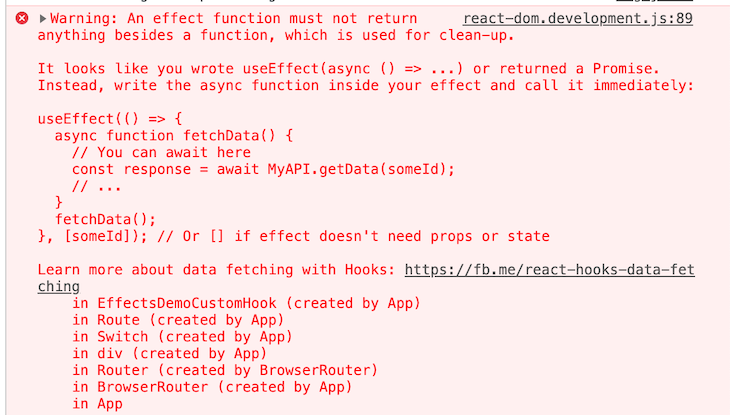
The mighty ESLint plugin likewise warns you almost information technology.
The reason is that this code returns a hope, merely an outcome can simply return void or a cleanup function. If you want to understand the event in farthermost detail, you tin read more here.
Unit testing of effects
Extracting useEffect blocks into custom Hooks allows for unit testing them because you don't have to deal with the actual React component. This is a major benefit.
Some fourth dimension agone, I wrote an article virtually unit of measurement testing custom Hooks with react-hooks-testing-library. This is one possibility to test effects.
The following snippet is a Jest example that tests data fetching fifty-fifty with changing one of the effect's dependencies (url) during runtime.
import { renderHook } from "@testing-library/react-hooks"; import axios from "axios"; import MockAdapter from "axios-mock-adapter"; // import custom hook - in this case extracted to a separate file import useFetch from "./useFetch"; examination("useFetch performs multiple Become requests for different URLs", async () => { // fetch 1 const initialValue = "initial value"; const mock = new MockAdapter(axios); const mockData = 1; const url = "http://mock"; mock.onGet(url).reply(200, mockData); const { result, waitForNextUpdate } = renderHook(() => useFetch(url, initialValue) ); expect(result.electric current.data).toEqual("initial value"); expect(result.current.loading).toBeTruthy(); await waitForNextUpdate(); expect(result.current.information).toEqual(ane); expect(result.current.loading).toBeFalsy(); // fetch 2 const url2 = "http://mock2"; const mockData2 = 2; mock.onGet(url2).answer(200, mockData2); const initialValue2 = "initial value 2"; const { result: result2, waitForNextUpdate: waitForNextUpdate2 } = renderHook( () => useFetch(url2, initialValue2) ); expect(result2.current.information).toEqual("initial value 2"); wait(result2.electric current.loading).toBeTruthy(); await waitForNextUpdate2(); look(result2.current.data).toEqual(2); wait(result2.current.loading).toBeFalsy(); }); useFetch is wrapped in a renderHook function call. This provides the correct context to execute the custom Hook without violating the rules of Hooks.
To perform the actual network call, we utilise waitForNextUpdate. This allows us to wait for the asynchronous office to return in gild to check the response from the network call. With this set, nosotros can assert the result of our Hook. In our test, we mocked the actual network call with axios-mock-adapter.
You lot can also discover this code in a CodeSandbox.
Some more useEffect receipts
In this section, I'll show you some handy patterns that might be useful.
Execute an result but once when a sure status is met
As we already know, y'all control the execution of effects mainly with the dependency assortment. Every time ane of the dependencies has inverse, the upshot is executed. Mostly, y'all should design your components to execute effects whenever a state changes, non simply one time.
Sometimes, however, you want to exercise exactly this — e.g., when a certain event has occurred. You lot tin can do this with flags that yous use within an if statement inside of your effect. The useRef Hook is a good option if you don't want to add an extra render (which would exist problematic most of the time) when updating the flag. In addition, you practice non have to add the ref to the dependency array.
The following example calls the office trackInfo from our event only if the following weather condition are met:
- The user clicked the push at least once
- The user has ticked the checkbox to allow tracking
After the checkbox is ticked, the tracking function should only be executed later on the user clicks in one case once more on the button.
office EffectsDemoEffectConditional() { const [count, setCount] = useState(0); const [trackChecked, setTrackChecked] = useState(faux); const shouldTrackRef = useRef(false); const infoTrackedRef = useRef(simulated); const trackInfo = (info) => console.log(info); useEffect(() => { console.log("useEffect"); if (shouldTrackRef.electric current && !infoTrackedRef.current) { trackInfo("user found the button component"); infoTrackedRef.current = true; } }, [count]); console.log("render"); const handleClick = () => setCount((prev) => prev + i); const handleCheckboxChange = () => { setTrackChecked((prev) => { shouldTrackRef.current = !prev; return !prev; }); }; return ( <div> <p> <label htmlFor="tracking">Proclamation of consent for tracking</label> <input name="tracking" type="checkbox" checked={trackChecked} onChange={handleCheckboxChange} /> </p> <p> <push onClick={handleClick}>click me</push button> </p> <p>User clicked {count} times</p> </div> ); } In this implementation, nosotros utilized two refs: shouldTrackRef and infoTrackedRef. The latter is the "gate" to guarantee that the tracking function is simply invoked in one case after the other weather are met.
The upshot is rerun every time count changes, i.east., whenever the user clicks on the push button. Our if statement checks the weather and executes the actual business logic merely if it evaluates to true.
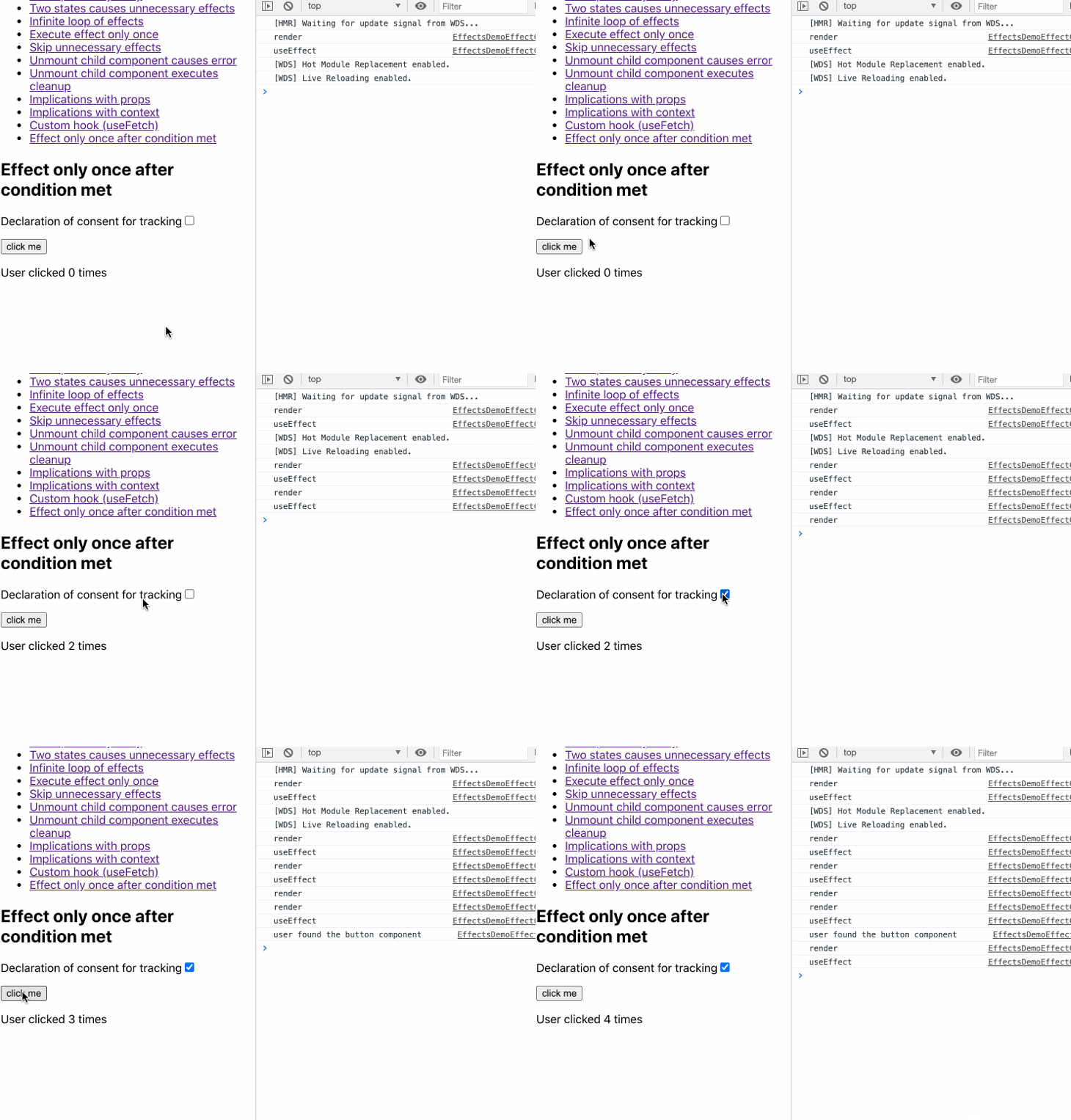
The log bulletin user constitute the button component is only printed one time later the right weather condition are met.
Access data from previous renders
If you lot need to admission some data from the previous return cycle, you lot can leverage a combination of useEffect and useRef.
function EffectsDemoEffectPrevData() { const [count, setCount] = useState(0); const prevCountRef = useRef(); useEffect(() => { panel.log("useEffect", `land ${count}`, `ref ${prevCountRef.current}`); prevCountRef.current = count; }, [count]); const handleClick = () => setCount((prev) => prev + 1); console.log("render"); return ( <div> <p> <push button onClick={handleClick}>click me</push button> </p> <p> User clicked {count} times; previous value was {prevCountRef.current} </p> </div> ); } We synchronize our effect with the state variable count so that it is executed afterward the user clicks on the button. Within of our effect, we assign the current value of the state variable to the mutable current property of prevCountRef. We output both values in the JSX section.
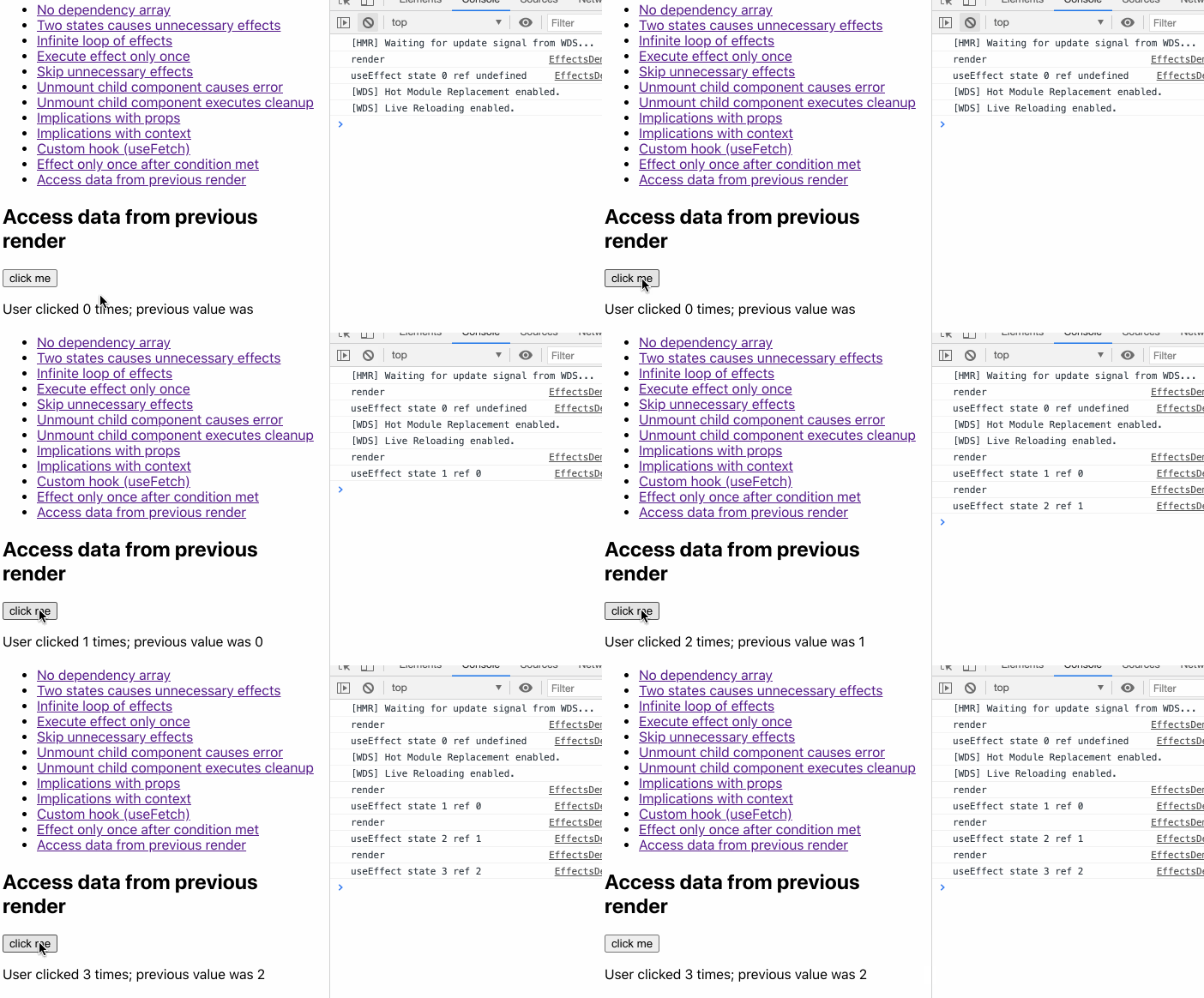
On loading this demo, on initial render, the country variable has the initial value of the useState call. The ref value is undefined. It demonstrates one time more than that furnishings are run later on return. When the user clicks, it works as expected.
Conclusion
In my stance, agreement the underlying design concepts and all-time practices of the useEffect Hook is a key skill to master if you lot wish to become a next-level React programmer.
If you started your React journeying before early 2019, then you have to unlearn your instinct to think in lifecycle methods and instead think in effects.
By adopting the mental model of furnishings, y'all'll get familiar with the component lifecycle, information menstruum, other Hooks (useState, useRef, useContext, useCallback, etc.), and even other optimizations similar React.memo.
Full visibility into product React apps
Debugging React applications can exist difficult, especially when users feel issues that are hard to reproduce. If you're interested in monitoring and tracking Redux land, automatically surfacing JavaScript errors, and tracking slow network requests and component load time, try LogRocket. 
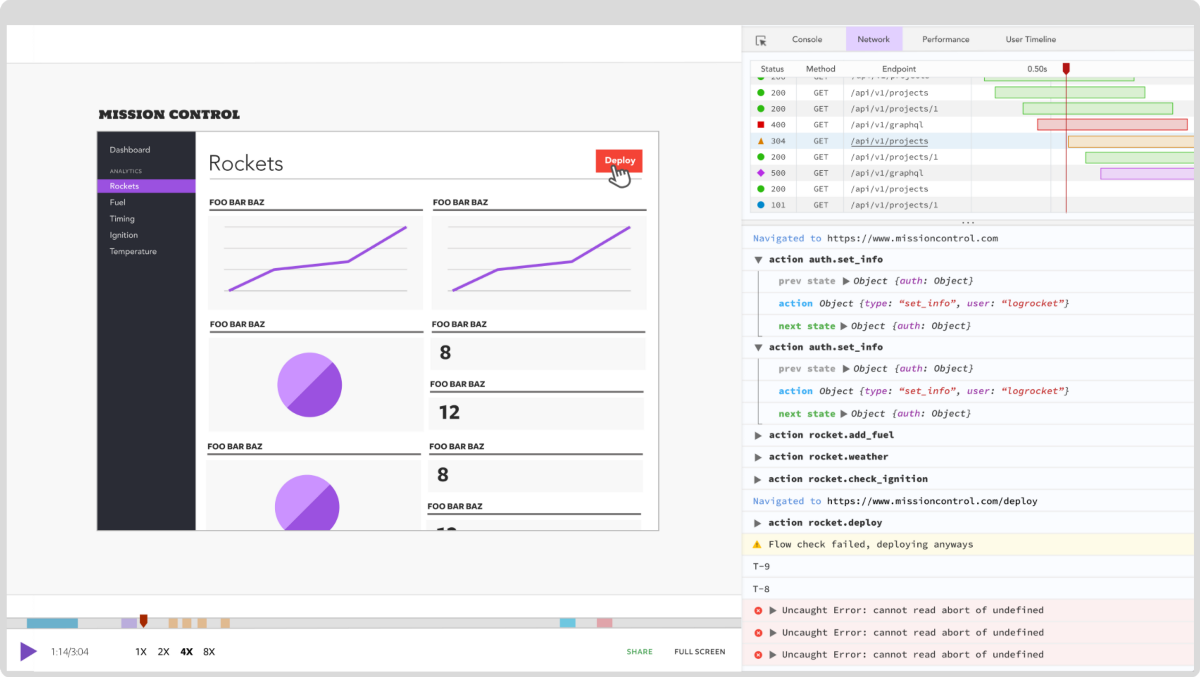
LogRocket is like a DVR for spider web and mobile apps, recording literally everything that happens on your React app. Instead of guessing why problems happen, yous can aggregate and written report on what state your application was in when an issue occurred. LogRocket also monitors your app's performance, reporting with metrics like client CPU load, client retention usage, and more.
The LogRocket Redux middleware packet adds an extra layer of visibility into your user sessions. LogRocket logs all actions and state from your Redux stores.
Modernize how you debug your React apps — start monitoring for free.
stone-wiggwhatife.blogspot.com
Source: https://blog.logrocket.com/guide-to-react-useeffect-hook/
0 Response to "Recall a Method When Component Url Is Hit Again"
Post a Comment